Pulse
Local Business Acquisition Marketplace
Browse a business the way you browse a neighborhood.
- Design · Engineering
- 2026
- Web · Marketplace
- Solo — Design & Engineering
- Buyers, sellers, and operators in SoCal
- Marketplace · Local · Maps
I designed and built the marketplace experience, frontend, and listing API.
Overview
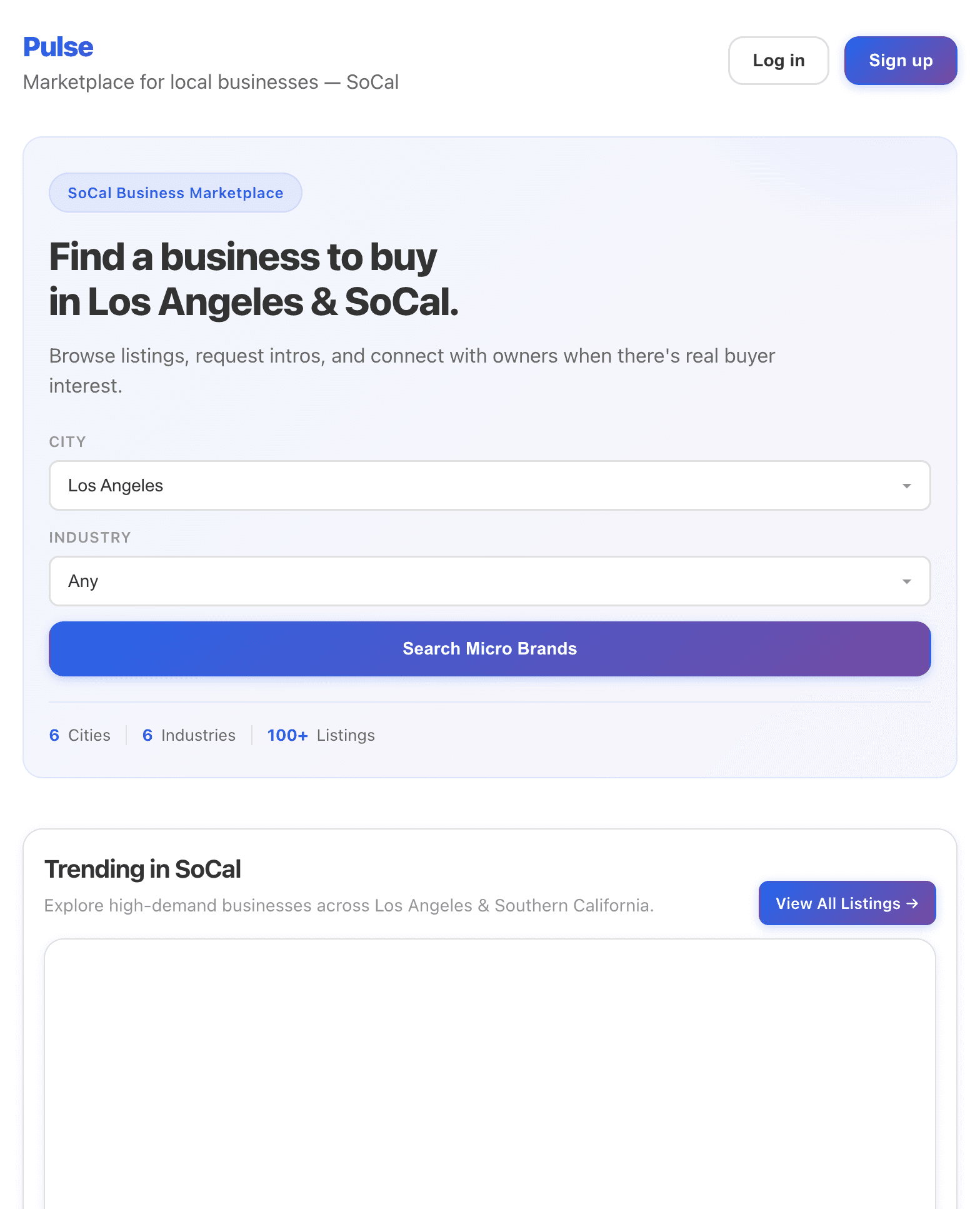
Pulse puts neighborhood, listing signals, and owner outreach into one map-first browse loop.
Local business listings had deal data, but almost no sense of place.
- 6+
- 10+
- E2E
Problem
Deal Lists Hide the Neighborhood
Buyers think in places—Silver Lake, Pasadena, Santa Monica. Traditional listing tables flatten that context into a zip code.
- Listings fragmented across platforms
- Location reduced to a filter
- Demand invisible until broker outreach
Core decision
Make the Map Carry the Deal
The map is not supporting chrome. It is the primary index, with listing signals attached directly to place.
- Markers expose useful listing context
- Clusters protect scanability at city scale
- Cards and map remain in the same state
Product system
One Browse Loop Across Screens
Desktop uses a persistent split view. Mobile turns the same map-and-card relationship into a bottom sheet.
- City and industry filters preserve map position
- Listing detail returns to the same browse state
- Owner introductions stay inside the marketplace
Current state
From Map Browse to Owner Intro
The complete path is implemented across Southern California: discover, compare, open a listing, and request an introduction.
- 6+
- 10+
- 5
- Live
Reflection
Key Learnings
Geography Is the Primary Filter
The neighborhood comes before the spreadsheet.
Markers Can Carry Data
Useful markers reduce clicks without turning the map into noise.
Full-Stack Ownership Is Speed
Performance problems became product fixes, not handoff tickets.